How it worked
Every piece was the same shape: a photograph of the person or the team, their story in their own words, and a thank you from me and the factory manager. It ran alongside the formal recognition program and carried no reward of its own.
- Found the stories by walking the floor and asking why, never through a nomination form or a committee.
- Most of the people featured worked production and had never been asked to talk about their work.
- Published through town halls, digital signage, and SharePoint so employees without a desk or a company email still saw them.
- Ran the full year across every shift and every location, more than 30 stories covering departments and individuals from the floor to customer-facing roles.
- Partway through, employees started nominating each other. That was the turn. The series stopped being something communications assigned and became something the workforce ran.
The format
Every piece ran the same way. A green field, two staggered yellow bands carrying the series name and the line that finished it, a photograph of the actual people on the factory floor, a short bold subhead, and copy naming each person. The bands made it recognizable in a second on a screen somebody walked past. The finish line did the strategic work, flexing between “who” and “to” depending on the story: who takes pride in their work, to continuously improve, to make safety a habit, to inspire the next generation.
end of line crew
The last look before the customer’s.
Everything every other team builds comes down to what end of line inspection catches. They are the final check between the factory and a farmer’s field.
cab assembly team
The tour’s best moment starts here.
Cab assembly works in a building off the tour route, anchoring the connections that make the cab drop look effortless. No visitor ever sees them do it.
third-shift tool maker
Overnight work nobody sees.
Custom parts made on third shift are why first shift walks in to tools that work. Day shift rarely knew who to thank for it.
Layout recreation showing the format only.
The printed series
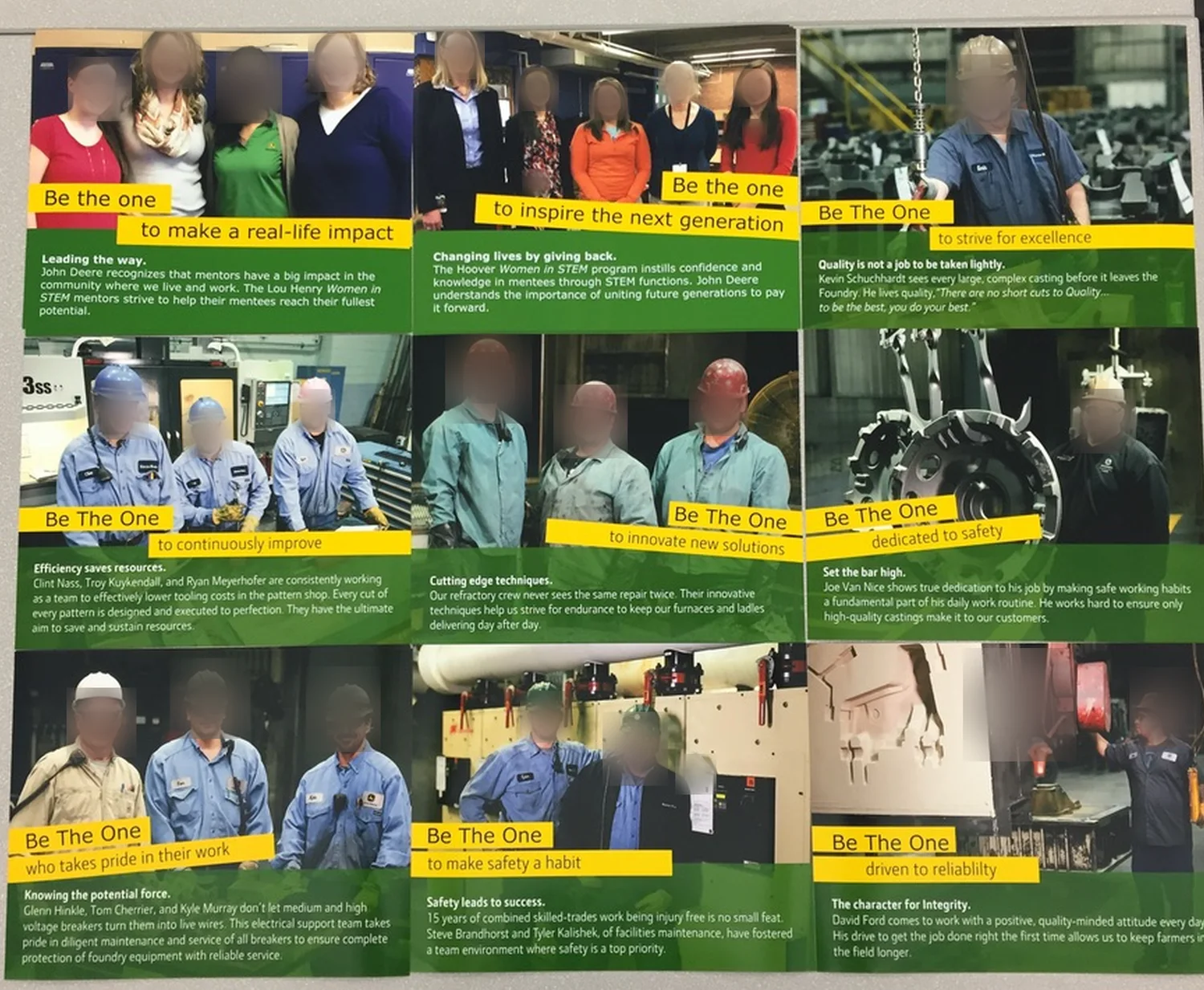
Nine of the series laid out together. Every piece led with a photograph of the actual people, most of them team shots taken on the floor. Faces are blurred here on purpose: these employees agreed to appear in a John Deere internal series, not on a personal portfolio.
What it was really about
Building up people who were humbly making John Deere better or making a customer smile. A sincere thank you, or a real note telling someone you appreciate them, is its own kind of recognition, and people can tell the difference between that and a program.
What the series did was encourage others by showing that people goals are not something you go do. They should be something you already do.
“The cabs were built in another building, off the tour route. The people who anchored those connections, who made sure it would be a perfect fit, set the stage for all of it and never saw a visitor. Nobody had written about them. So I did.”
From a 2026 cover letter